On Wednesday night the Chicago Fire and Inter Miami drew 1-1 at Soldier Field in front of 63,094 people, a new home attendance record for the Fire. Robert Lewandowski, who joined Chicago in late June, scored after ten minutes. Lionel Messi set up Casemiro’s equalizer from a corner. The previous record had been set by the same fixture a season earlier, which tells you something about who fills the lakefront stadium when Messi comes to town.
Whether you are coming for the Fire, the Bears or a stadium concert, the logistics are the same. Soldier Field is one of the easiest big stadiums in the US to reach without a car, as long as you know which station to use.
Where Soldier Field is, and why you should not drive
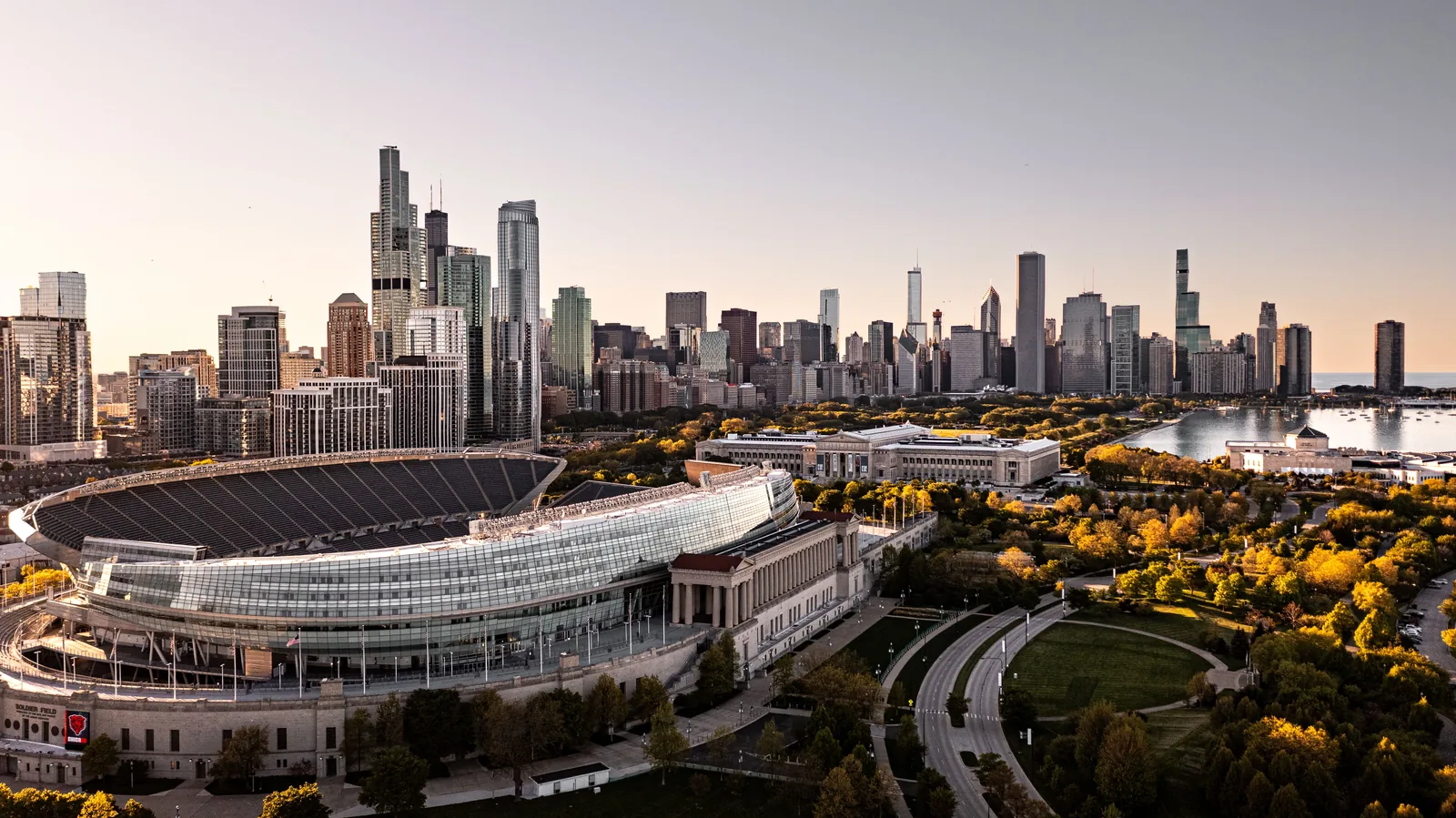
The stadium sits on the lakefront on Chicago’s Near South Side, inside the Museum Campus, with Lake Shore Drive on one side and Lake Michigan on the other. It opened on October 9, 1924. Between 2002 and 2003 its interior was demolished and rebuilt in a renovation that cost $632 million in total, which is why a modern glass-and-steel bowl now rises out of the original stone colonnades. The makeover was controversial enough that Soldier Field lost its National Historic Landmark designation in 2006.
It is also compact by NFL standards: a football capacity of 62,500 makes it the league’s second-smallest stadium. That is part of why the transit options work. The crowd is big, but not overwhelming, and the downtown rail network is a short walk away. Driving is the one option that reliably goes wrong. Event parking near the lake is expensive, and leaving along Lake Shore Drive after a sellout is slow.
By L train: Roosevelt
Roosevelt is the closest L station to Soldier Field and the Museum Campus, about half a mile (800 meters) to the east, or roughly a ten-minute walk toward the lake along Roosevelt Road. It is really two stations joined by a transfer tunnel that opened in 2002:
- Roosevelt/State, underground, on the Red Line.
- Roosevelt/Wabash, elevated, on the Green and Orange Lines.
Three lines means that from almost any hotel in the Loop, River North or the South Loop you can reach Roosevelt without more than one change.
By Metra and by bus
If you are staying in the suburbs, or coming in from northwest Indiana, Metra’s Museum Campus/11th Street station is on the lakefront just north of the stadium, and 18th Street station serves the south end. Both sit on the Metra Electric line.
On big event days the CTA runs the #128 Soldier Field Express bus, which links the stadium with the main commuter rail terminals downtown. It is built around Bears games and the largest events, so check the CTA’s service alerts before a Fire match or a concert rather than assuming it will be running.
From O’Hare and Midway
Chicago is a rare city where both airports have a direct rail line into town, and one of them goes straight to the stadium’s station.
- From Midway: take the Orange Line toward the Loop and get off at Roosevelt. No change needed.
- From O’Hare: take the Blue Line into downtown, change to the Red Line at Jackson, where the two lines are connected underground, and ride south to Roosevelt.
If you have a choice of airports for a match weekend, Midway’s one-seat ride is the better deal. It also brings you into the south end of the Loop, the side of downtown closest to the stadium.
Make a day of it on the Museum Campus
Soldier Field’s neighbors are three of Chicago’s best-known museums. The Field Museum sits directly north of the stadium, the Shedd Aquarium is on the lakeshore beyond it, and the Adler Planetarium is at the tip of the peninsula looking back at the skyline. South of the Adler, Northerly Island is a quiet stretch of parkland on the lake, and the Lakefront Trail runs past all of it.

For an evening kickoff, the natural plan is a museum in the afternoon, a walk along the lake, and a short stroll to the gates. Just remember that on match days the whole campus fills up with fans, so the museums get busier and the paths get slower as kickoff approaches.
Soldier Field crowds like this have an expiry date
The Fire have been back at Soldier Field since the 2020 MLS season, after paying to leave their lease at the soccer-specific stadium in suburban Bridgeview. They will not be there forever. In June 2025 owner Joe Mansueto announced McDonald’s Park, a privately funded, 22,000-seat soccer stadium costing about $750 million. It will anchor The 78, a new development along the Chicago River just south of Roosevelt Road, and it is expected to open in 2028.
A purpose-built stadium will be better for most Fire games. But a 63,000-strong crowd on the lakefront for Messi is the kind of night that only happens while the club plays in a stadium this size, so if a big name is on the fixture list in the next couple of seasons, it is worth the trip.
Quick checklist
- Take the Red, Green or Orange Line to Roosevelt and walk east about ten minutes.
- From Midway, the Orange Line goes straight to Roosevelt.
- From O’Hare, Blue Line to Jackson, then Red Line south.
- Check whether the #128 bus is running before you rely on it.
- Leave the car at the hotel.
If you are turning the match into a longer Midwest trip, our Chicago to Milwaukee road trip covers the drive north, and our guide to the Presidents Cup at Medinah covers a trip out to the western suburbs.