

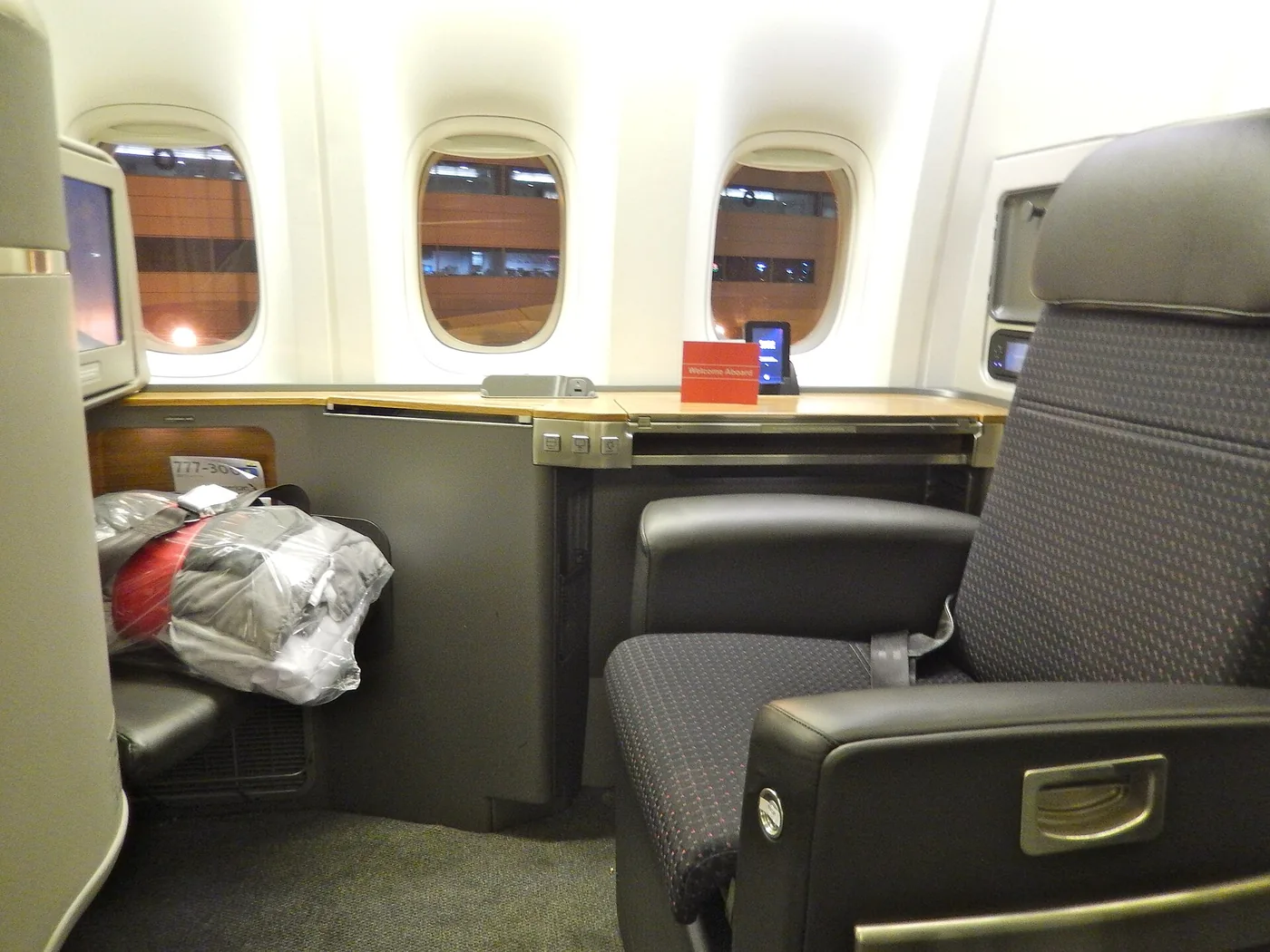
American Airlines flew the first commercial service of its reconfigured Boeing 777-300ER on 2 September, New York JFK to Buenos Aires, and searches for “American Airlines first class” have been climbing ever since. The irony is that the aircraft everyone is looking up is the one that ends first class at the airline. There is no Flagship First on it. The top cabin is now a suite with a door, and there are seventy of them.
This is what the change actually means if you are the one booking the ticket: what is on the aeroplane, where it flies, when the old first class disappears for good, and how to avoid paying for a seat you never get to sit in.
What Is Actually on the Aircraft
The premium-configured 777-300ER carries 70 Flagship Suite seats with privacy doors, 44 Premium Economy seats and 30 Main Cabin Extra seats — 144 premium seats on a single airframe. That number is the story. Airlines do not fit a third of a widebody with lie-flat suites unless they have concluded that the people at the front are paying for the aeroplane, and American has said as much by building the fleet this way rather than adding a handful of showpiece seats.
For a traveller, a wide business-class cabin has one very practical consequence: availability. Seventy suites is a lot of inventory to fill on a Tuesday in February, and cabins that large tend to produce more upgrade space and more reasonable cash fares outside peak weeks than the eight-seat first-class cabins they replace.
The End of Flagship First, With Dates
Two dates matter, and both are already published. Flagship First will no longer be available for purchase on the Boeing 777-300ER for travel beginning 19 November 2026. It also disappears from transcontinental routes for travel beginning 28 March 2027.
If you hold a booking in Flagship First beyond those dates, or you are sitting on miles you had earmarked for it, that is the deadline to work against. If you have been waiting for a fare sale to try the old cabin, the window is closing rather than reopening.
Where the Aircraft Actually Flies
The 777-300ER fleet is 20 aircraft, and American has named the destinations they serve: London, Tokyo, São Paulo, Buenos Aires and Sydney. That is a short list, and it is the single most useful fact in this article. You cannot simply buy an American long-haul ticket and expect a suite; you have to be flying one of those routes, on a day the reconfigured aircraft is scheduled.
London is the route most readers will meet first, because it is the one with several daily departures and the widest range of fares. If you are building a trip around it rather than the other way round, our guide to building a London trip around a night at The O2 is a good way to make the flight the cheap part of the week rather than the whole point of it.
What You Get in the Suite
The Flagship Suite has a privacy door and what American describes as a chaise lounge seating position — a middle setting between upright and flat that most business-class seats do not offer and that matters more than it sounds on a fourteen-hour sector. The bedding includes a mattress pad and a cool-touch, dual-sided pillow. Dining is multicourse, paired with the airline’s wine list.
Premium Economy on these aircraft gets wireless charging, water bottle storage and both USB-C and AC power at every seat — a small list that quietly solves the three things that go wrong in that cabin. Every aircraft in the configuration carries free high-speed inflight Wi-Fi, sponsored by AT&T.
How to Actually End Up in One
- Check the equipment before you pay. The seat map, not the marketing page, is what tells you which aircraft is scheduled on your date. A 777-300ER is coded 77W in most booking tools.
- Assume the aircraft can change. Airlines swap equipment for maintenance and demand, sometimes days out, sometimes at the gate. Do not pay a large premium for a specific cabin on a specific flight unless you can accept getting the older one.
- Fly the routes, not the hope. Five destinations carry these aircraft. Every other American long-haul route is a different product.
- Consider Premium Economy as the value play. On a 44-seat cabin with real power and storage, the gap in comfort from economy is larger than the gap in price.
- Book the long sectors. Sydney and Buenos Aires are where a flat bed changes what you can do with your first day on the ground. On a seven-hour hop to London it is a luxury; on a fifteen-hour night it is the difference between arriving and recovering.
Is It Worth Planning a Trip Around?
A seat is not a destination. But long-haul travel is one of the few parts of a trip where money buys something measurable — not a nicer view, but a night of sleep and a usable first morning. If you were already flying to Tokyo or Sydney, the reconfigured 777 is a reason to pick American over a cheaper connection. If you were not, it is not a reason to go.
And whatever cabin you are in, the aeroplane is still the fragile part of the itinerary. Weather, air traffic control and airport disruption do not care what your seat cost, as anyone who has read our account of a bad week at Gatwick will recognise. Build the trip so that a delayed flight costs you an evening, not the reservation you flew there for.
Photos: Venkat Mangudi, CC BY 2.0, via Wikimedia Commons; Sarah Ackerman, CC BY 2.0, via Wikimedia Commons.




.jpg)
